


SMD vs COB LED: which one is right? The question comes up in almost every professional LED wall project, and the answer has a direct effect on image quality, how long the investment lasts and what the screen costs to run.
SMD (Surface Mounted Device) has led the market for more than a decade: each LED is mounted individually on the circuit board. COB (Chip on Board) is the newer approach, with the chips placed directly on the substrate and sealed under a single protective layer.
The difference goes beyond construction. It affects viewing angle, colour uniformity, mechanical strength, serviceability and, of course, budget. A P1.86 SMD LED display and a P1.86 COB display deliver the same resolution, but they look and behave differently in use. Browse our indoor LED displays to see the range.
SMD vs COB at a glance
SMD vs COB in one line: choose SMD for viewing distances above 1.5-2 metres, limited maintenance budgets, outdoor use and rental; choose COB for close viewing, seamless surfaces and demanding indoor environments.
- SMD vs COB image quality: COB looks smoother under 1 metre, and the difference fades beyond 2 metres.
- SMD vs COB protection: COB typically reaches IP54, against IP43 for standard SMD.
- SMD vs COB repairs: SMD allows single-LED replacement, while COB needs the whole module replaced.
- SMD vs COB cost: COB usually costs 15-25% more at the same pixel pitch and size.
What you will learn in this SMD vs COB guide
This SMD vs COB guide explains how the two technologies are built, how they compare in real installations and how to choose between them. You will find comparison tables with measurable figures, examples by sector and a section on when each technology is the wrong choice. The aim of this SMD vs COB comparison is to help you make an informed decision, not to push a generic recommendation.
SMD vs COB: SMD technology, mature and flexible
In an SMD display, discrete LEDs are mounted on the surface of the PCB. Each pixel combines three separate LEDs, red, green and blue, each in its own package. This modular design keeps production flexible and repairs simple: a damaged LED can be replaced on its own with standard SMT soldering equipment.
SMD displays come in a wide range of pixel pitches, from P1.53 to P10 and above, so each project can be configured for its purpose. A P2.6 SMD LED wall offers the best value for mid-sized events viewed from 3 to 5 metres, while P1.86 suits luxury retail and premium corporate spaces that need higher definition.
The biggest advantage of SMD is maturity: established manufacturing, a dependable global supply chain and lower costs. A 500×500 mm P2.6 SMD rental LED display typically costs 15-20% less than its COB equivalent, and the gap widens on large installations.
Its main limitation is uniformity at close range. Under about 1.5 metres the individual LEDs become visible and the image can look grainy, which is a problem wherever viewers get close to the screen.
SMD vs COB: COB technology, seamless and protected
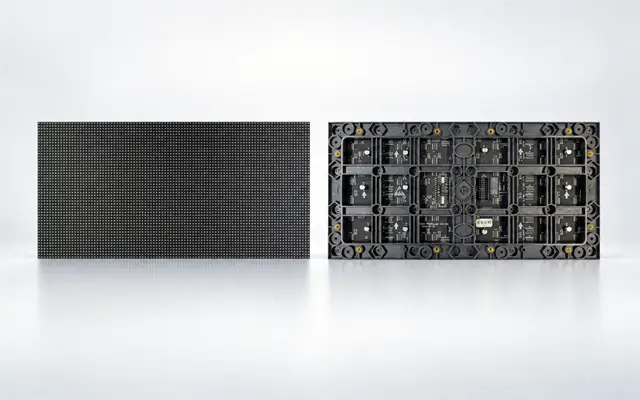
COB places the LED chips directly on the PCB, with no individual packages, and covers the entire surface with a protective layer of epoxy resin or silicone. The result is a continuous, uniform surface without the dark gaps between pixels that characterise SMD.
The benefit is clearest at fine pixel pitches (P1.53 to P2). Viewed from 50 centimetres, a P1.86 COB display looks like one smooth surface, while its SMD counterpart shows the structure of the individual LEDs. That makes COB indoor displays a natural fit wherever people stand close to the screen: luxury retail, automotive showrooms, museums and control rooms.
The second advantage is protection. The resin layer shields the chips from impact, dust and humidity and raises the IP rating, typically IP54 against IP43 for standard SMD modules. In dusty environments, or places where knocks are likely, this significantly extends service life.
The trade-off is serviceability. The sealed surface does not allow repairs at pixel level: a faulty pixel means replacing the whole COB module, which takes specialist equipment and costs more. If your maintenance budget is tight, weigh this carefully.

SMD vs COB performance in numbers
In the SMD vs COB comparison, COB has a measurable edge in viewing angle and contrast. A COB module typically reaches a 160° horizontal viewing angle against 140° for standard SMD, so colours stay consistent for people seated off to the side.
Contrast benefits from the uniform black surface between pixels: 5000:1 or higher, against about 3000:1 for SMD. Under strong ambient light, that difference makes content easier to read.
Heat is where SMD keeps a structural advantage. Discrete LEDs shed heat more efficiently than an integrated COB surface, which allows higher peak brightness in dense configurations. For outdoor projects that need 5000 nits or more, SMD remains the better choice.
Both technologies work with the same professional video processors. NovaStar's VX1000 Pro, for example, drives SMD and COB displays alike, with professional colour calibration and native 4K handling.
SMD vs COB: when each technology is the wrong choice
Avoid SMD if viewers will be within a metre of the screen, if the environment carries a risk of frequent impact, or if the client expects a perfectly uniform surface. In premium automotive showrooms and luxury retail, where a seamless look is essential, COB delivers better results.
Avoid COB if your maintenance budget is limited, if you need maximum outdoor brightness (above 6000 nits), if repairs must be done quickly on site, or if you are working with pixel pitches above P3, where the uniformity advantage fades. For rental work with frequent set-up and teardown, the toughness and quick repairability of SMD still win.

SMD vs COB comparison tables
The SMD vs COB choice comes down to measurable parameters. The first table compares SMD vs COB side by side. The second matches each application to the technology that suits it best.
Table 1: technical comparison, SMD vs COB
| Parameter | SMD | COB | Advantage |
|---|---|---|---|
| Visual uniformity | Good (viewing distance over 2 m) | Excellent (even under 1 m) | COB |
| Viewing angle | 140° horizontal | 160° horizontal | COB |
| Contrast | 3000:1 typical | 5000:1+ typical | COB |
| IP protection | IP43 standard | IP54 typical | COB |
| Impact resistance | Medium | High | COB |
| Repairability | Single LED replaceable | Whole module replaced | SMD |
| Repair cost | Low | High | SMD |
| Initial cost | Standard | 15-25% higher than SMD | SMD |
| Heat dissipation | Excellent | Good | SMD |
| Maximum brightness | 6000+ nits | 4500 nits typical | SMD |
| Technology maturity | High (15+ years) | Medium (5 years) | SMD |
| Component availability | Immediate, worldwide | Fewer suppliers | SMD |
Table 2: SMD vs COB, recommended technology by application
| Application | Technology | Pixel pitch | Dison products | Why |
|---|---|---|---|---|
| Luxury retail (viewing distance under 1.5 m) | COB | P1.53-P1.86 | Fixed COB LED display | A seamless surface is critical |
| Standard retail (2-3 m) | SMD | P1.86-P2.5 | Fixed SMD LED display | Best quality for the price |
| Corporate meeting rooms | COB | P1.86-P2 | Fixed COB LED display | Viewers are often close |
| Corporate lobby or reception | SMD | P2-P2.5 | Fixed SMD LED display | Suitable distance, controlled budget |
| 24/7 control room | COB | P1.53-P2 | Fixed COB LED display | Reliability and uniformity |
| Indoor rental events | SMD | P1.95-P2.9 | 500×500 mm rental LED wall | Fast repair is essential |
| Outdoor rental events | SMD | P2.6-P4.8 | Outdoor rental LED wall | Brightness and robustness |
| Automotive showroom | COB | P1.53-P1.86 | Fixed COB LED display | A premium experience is expected |
| Stadiums and large venues | SMD | P6.67+ | Stadium series | Viewing distance over 10 m, lower cost |
SMD vs COB: Dison products by technology
Dison offers both technologies, with configurations tuned to each scenario.
Fixed indoor SMD. Dison fixed SMD LED displays cover pixel pitches from P1.53 to P3.07 in 320×160 mm (modules), 320×640 mm, 640×480 mm and 640×640 mm formats. SMD gives you flexible configuration and low running costs, which suits standard corporate installations, retail with viewing distances over 2 metres, and projects where quick repair is a priority. See the indoor LED display range.
Fixed indoor COB. Dison fixed COB LED displays offer the same pitch range with a uniform, protected surface. COB shines in premium installations where people are often close to the screen and a seamless look is non-negotiable: control rooms, luxury retail and showrooms. See the COB LED Display Real Pixel Series.
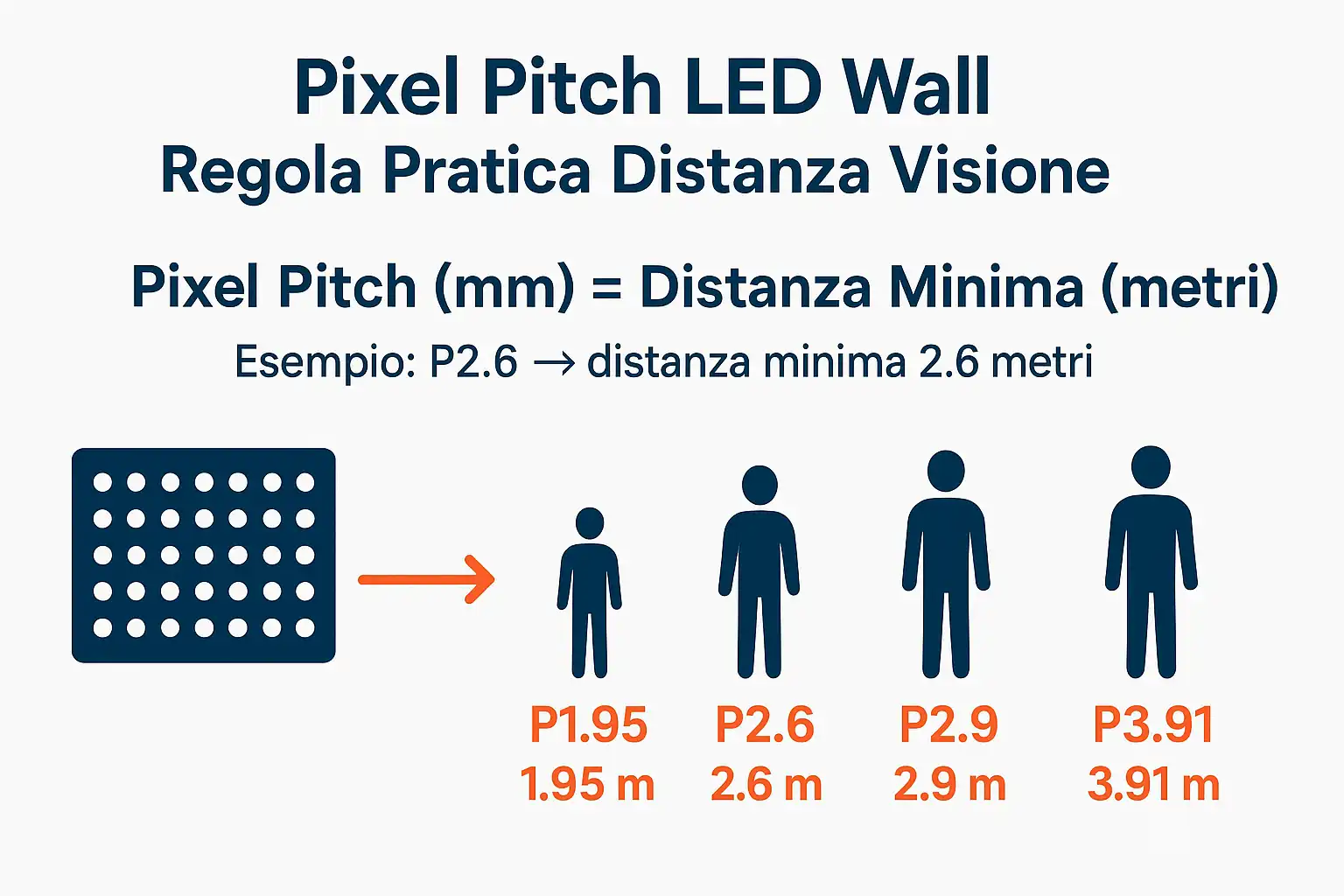
Rental 500×500 mm. The Dison rental series uses SMD only, for robustness and quick repair. The P1.95, P2.6, P2.9 and P3.91 indoor LED walls (plus outdoor variants from P2.6 to P4.8) have a fast-lock system, low weight and fast on-site maintenance. For temporary events where speed and reliability matter most, SMD is the professional choice. See the rental LED wall range.
Video processors. All Dison displays, SMD and COB, work natively with NovaStar video processors. The VX400 Pro handles configurations of up to 2.3 million pixels, and the VX1000 Pro scales to 8.8 million with native 4K. Colour calibration works the same way on both technologies, so colour stays uniform. See the LED media player range.
SMD vs COB: when to choose SMD
Choose SMD when viewing distances are above 1.5-2 metres, the maintenance budget is limited, fast on-site repair matters or you need more than 5000 nits. Rental installations and temporary events benefit from its robustness and easy servicing.
SMD vs COB: when to choose COB
Choose COB when viewers are within a metre of the screen, the environment carries a risk of impact or dust, a continuous surface is critical, or the project is premium and the budget allows. 24/7 control rooms, luxury retail and automotive showrooms are the ideal cases.
SMD vs COB LED: frequently asked questions
The difference is in how the display is built. In SMD, discrete LEDs are mounted individually on the PCB, and each pixel uses three separately packaged LEDs (red, green and blue). In COB, the chips sit directly on the substrate and the whole surface is sealed under a continuous layer of epoxy resin or silicone. That leads to different behaviour in use: SMD is easier to repair and costs less, while COB offers better uniformity and stronger protection.
SMD usually costs 15-25% less than COB at the same pixel pitch and size. Running costs should be judged over the whole life cycle: SMD needs more frequent but cheaper repairs, while COB needs fewer but more expensive module replacements thanks to its protection. On permanent installations over 5 years, the total cost of ownership tends to converge.
In demanding environments, yes. The resin layer protects the chips from impact, dust and humidity, typically giving IP54 against IP43 for standard SMD. In 24/7 control rooms or places where knocks are likely, COB extends service life and cuts early failures by 30-40%. SMD is still preferable for rental, where fast on-site repair matters more than built-in robustness: single LEDs can be replaced in minutes without specialist equipment.
Not in the same way. An SMD display lets you replace a single LED with standard SMT soldering equipment: find the faulty LED, desolder it and fit a new one in 10-15 minutes. A COB display needs the whole LED module replaced, which takes specialist equipment and skills. A COB repair costs 3-6 times more, although failures are less frequent thanks to the protective layer. For projects with limited technical support, SMD is the more self-sufficient option.
COB looks better at close range, thanks to its continuous surface. Under 1 metre, a P1.86 COB display looks like one smooth surface, while the SMD equivalent shows its grainy structure. COB also has a wider horizontal viewing angle (160° against 140°) and higher contrast (5000:1 or more against about 3000:1 for SMD). Beyond 2 metres, however, the visible difference shrinks quickly, so SMD is a sensible choice for most standard corporate and retail applications.
COB was designed mainly for indoor use, where uniformity and protection matter most. Outdoor COB versions with IP65 protection exist, but they are a small part of the market and cost considerably more. For outdoor installations SMD is usually the better option: higher maximum brightness (6000+ nits against about 4500 for COB), excellent heat dissipation, repair on site and lower cost. Dison outdoor LED displays use SMD with IP65 protection and, in the Stadium series, up to 10000 nits, so content stays readable in full sunlight.
Under ideal conditions both last about the same: 100,000 hours (around 11 years of continuous 24/7 operation), with brightness falling to 70% of its initial value. The difference shows up in real conditions. In dusty environments, or where knocks are likely, COB keeps its performance better and can extend service life by 20-30% over SMD. SMD suffers more from mechanical stress, but its LEDs can be replaced one by one, which prolongs the life of the installation. In rental work, with frequent assembly and teardown, SMD's mechanical robustness and quick repair are decisive.
Yes. Professional video processors work with SMD and COB alike. The NovaStar processors Dison uses (VX400 Pro, VX600 Pro, VX1000 Pro and VX2000 Pro) drive both technologies without functional limits. Colour calibration, HDR handling and video mapping work the same way on both, so colour stays uniform whatever the LED technology. Choose the processor by the total resolution it must handle: the VX400 Pro supports up to 2.3 million pixels, and the VX1000 Pro scales to 8.8 million with native 4K.
Not necessarily. COB makes the most sense when viewers are under a metre from the screen and a continuous surface is an explicit requirement. Luxury automotive showrooms, premium retail at close range and control rooms where operators work within a metre all benefit from COB uniformity. But many premium corporate spaces, such as meeting rooms and company lobbies, are viewed from 2-3 metres, where the difference between SMD and COB is negligible. In those cases SMD delivers professional image quality with an investment 15-25% lower and greater operating flexibility.
COB shows its full advantage at fine pitches from P1.53 to P2, where surface uniformity is most visible. Above P2.5-P3 the difference from SMD narrows sharply and the COB premium becomes hard to justify. Dison COB displays cover P1.53 to P3.07, but the most requested configurations are P1.53, P1.86 and P2, for projects where close-range image quality is the top priority. If your project needs P2.5 or above, check whether the extra COB cost is justified by real benefits in your setting.
SMD vs COB: need help choosing?
Tell us about your project, your viewing distance and your environment, and our team will recommend the right technology and configuration.